
Domenico Fratianni. A man with light in his eyes. A life kindled by passion for Art and for his Land; a dense body of work, nourished by a fervid poetic imagination.
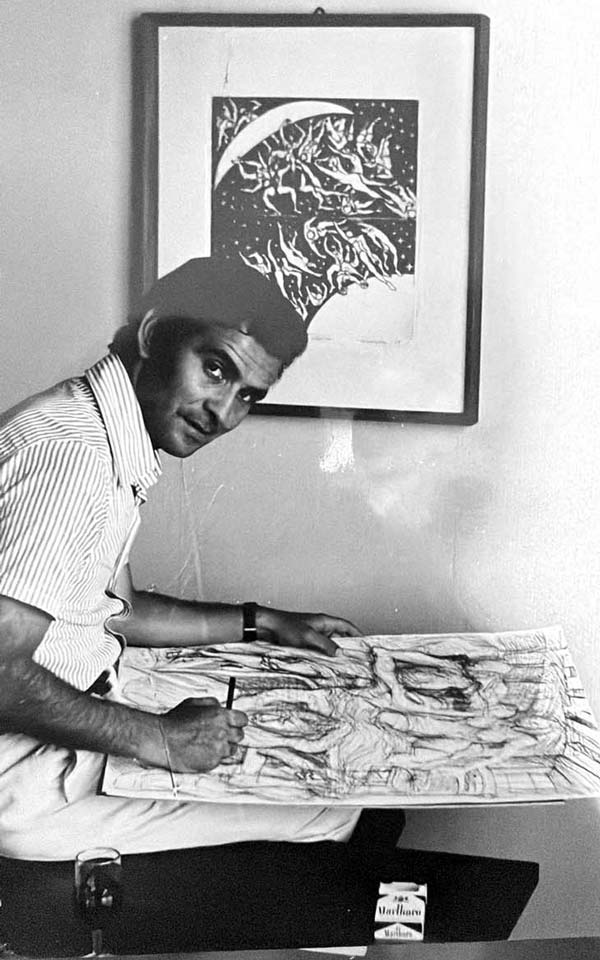
“I am a Mediterranean artist by cultural tradition. Someone once told me I am a Spaniard on loan to Molise, because I recall Velázquez, Picasso and the whole of modern cultural tradition: Gauguin, Van Gogh, Soutine. And that I am an Expressionist — that is what the critics say of me. I feel myself to be sun-drenched, Mediterranean, and at the same time bound to the human dimension: I believe in the capacity of man, of man at the centre of the world, in dialogue with himself, with his own limits, his own passions, his own loves, his hopes and his follies. All of this is in my crucible, where the dramatic image comes to be tempered into a positive note. I am a Mediterranean Expressionist painter inclined towards hope.”
Domenico Fratianni
Domenico Fratianni was a draughtsman, painter and engraver. He always worked in Molise and for Molise, while carrying his Art and his Land out into the world. Many have written about him, underlining the moral tension and the evocative power of his work. A passionate man and a fervent, prolific artist, he devoted himself to several figurative languages at once. Drawing was always the means by which he fixed the Idea, the lines and forms of his message, universal and profound whether as marks on paper, engraved on copper and zinc plates, or as a brushstroke charged with vivid, brilliant colours on his canvases. In everything he left behind lies his passion for life and for people — an interest one might call Vergaesque for the world of the peasantry in particular, for history’s defeated, for the defenceless, the least among us. The deep bond between Art and Literature in Fratianni’s artistic path has often been noted, evidenced by the trilogy on the creative madness of Don Quixote, Robinson Crusoe and Dino Campana; critics have pointed to his love of mad, losing characters who are, in truth, heroes: pure and stubborn men who, without ever winning a single battle, rose above a disillusioned and resigned everyday life, unable to accept its discrepancies, its superficiality.
There is something fascinating in the thought that everything can always be put back into play, and so the world itself could be changed, in the most genuine sense of the term. This is no accident, for Fratianni, with his great values and his unrelenting dreaming, struggled to accept daily compromise, to accept injustice. With his art he always denounced distortion and ugliness, in his never-tiring attempt to find Beauty and to give it back, without proclamations.
In the deep excavation, in the black and white of his engravings and in his fiery, matter-rich oils, he portrayed above all the landscapes of Molise and its humble people — the poetry of the effort of those who must earn their living, and do so in silence, which is respect, not resignation. He too had his Fathers, of course, and as he often said, he greatly loved the Expressionists: he did not go searching for clichés, but recognised in himself the same significance, because Expressionism is a movement that seeks explanations “within”, in man’s impressions, in his suffering, in lyricism, in his way of being in the world. The great Fathers do not therefore appear as citations, but rather as spontaneous encounters, born not of a wish to be like them but of a natural affinity, a natural meeting on converging paths.
1963-1964 – Open-air exhibition, Campobasso.
1965 – Nuoro, Galleria “Via Mazzini”.
1968-69 – Venice, Galleria d’arte moderna “Traghetto”
1970/71 – Campobasso, Galleria d’arte “Il Punto”.
1972 – Taranto, Centro Internazionale “Magna Grecia”
1973 – Campobasso, Circolo Sannitico.
1974 – Venice, Galleria d’arte “Segno Grafico”; Verifica ’74, Campobasso.
1975 – Acireale (Catania), Galleria d’arte “Accademia Ciclope”; Rome, Galleria d’Arte “Canovina”.
1976 – Tribute to Levi and Scotellaro, Campobasso; Florence, Galleria d’arte “Buca di Dante”.
1977 – Venice, Galleria dell’Incisione “Venezia Viva”.
1979 – Rome, Galleria d’Arte “Formastudio”.
1981 – Campobasso, Circolo Sannitico; “Prima rassegna d’arte Campobasso” (First Campobasso Art Exhibition), Campobasso, Galleria Comunale. Campobasso, Galleria Comunale, “La Sagra rivisitata”.
1982 – Venice, Galleria dell’Incisione “Venezia Viva”; Campobasso, Circolo Sannitico; Campobasso, Galleria Comunale.
1983 – Marseille (France), Istituto Italiano di Cultura; Galleria-Libreria “Remo Croce”, Rome.
1984 – Campobasso, Galleria Civica “Palazzo San Giorgio”
1985 – Pisa, Galleria d’Arte “La Pantera”
1986 – Campobasso, Galleria Civica “Palazzo San Giorgio”; Rome, Libreria-Galleria “Remo Croce” (graphic art exhibition); Rome, Foro Italico, selection of graphic works on sporting subjects.
1987- Termoli, Castello Svevo.
1987 – 1988, Rome, Galleria-Libreria “Remo Croce”.
1988 – Campobasso, retrospective of Painting and Graphic Art.
1988-89 – Rome, Galleria-Libreria “Remo Croce”.
1989 – Colletorto, Torre angioina; Campobasso, Palazzo della Provincia, Don Chisciotte, freely drawn from Cervantes, graphic work.
1990 – Rome, Studio Canova, graphic and pictorial works.
1991 – Paris, Italian Chamber of Commerce for France.
1992 – Rome, Ministry of Cultural and Environmental Heritage, Complesso Monumentale di San Michele a Ripa.
1993 – Rome, Galleria-Libreria “Remo Croce”.
1994 – Istituto di Cultura di Aix-en-Provence (France), Palais de Congrès.
1995 – Termoli (Campobasso), Galleria Civica d’Arte Contemporanea; Campobasso, gymnasium of the Istituto “L. Pilla”.
1996 – “Don Chisciotte, freely drawn from Cervantes” – graphic work, Rome,
Palazzo Istituto Spagnolo di Cultura. “Il Cappello alla Rembrandt, tribute to Dino Campana”, Rome, Libreria “Remo Croce”.
1997 – Montagano (Campobasso), Palazzo del Comune (retrospective).
1998 – Campobasso, Regional Military Command of Molise (Painting and
Graphic Art exhibition).
1999 – Ferrazzano (Campobasso), Palazzo Chiarulli (retrospective of Graphic Art and Painting).
“Il cappello alla Rembrandt, tribute to Dino Campana”, Campobasso, Convitto Nazionale “M. Pagano”.
2001 – L’Aquila, Castello Cinquecentesco (retrospective of Painting and Graphic Art).
2002 – Campobasso, CONI – Molise Regional Committee (etchings, paintings and watercolour drawings on sporting subjects).
2003 – “L’evento sportivo” (The Sporting Event), Campobasso, Circolo Sannitico; Florence, Galleria “Centro storico”.
2006 – Campobasso, University of Molise, “La realtà come metafora” (Reality as Metaphor).
2008 – Campobasso, Convitto Nazionale “Mario Pagano”, “Fratianni e la Vita Nuova”.
2010 – “Il gesto sportivo come azione poetica” (The Sporting Gesture as Poetic Action), Castelpetroso (Isernia), Centro Messegué.
2013 – “Don Chisciotte e gli Invincibili”, Montagano (Campobasso), Pro Loco Faifoli.
2014 – “Domenico Fratianni: I segni dal profondo” (Signs from the Depths), Rome, Istituto Nazionale per la Grafica (Calcografia); Campobasso, Fondazione Molise Cultura. Retrospective of Painting and Graphic Art marking the 50th year of his artistic career.
2019 – “Le voci di dentro” (The Voices Within), retrospective of Painting, Matera, European Capital of Culture,
Circolo “La Scaletta”.
The editions in which the Maestro often worked alone were full of difficulties, but he faced them with uncommon conviction and determination.
It was thanks to this tenacity that, over the course of its history, the Biennale was able to pay tribute to great twentieth-century engravers who had passed away, such as Luigi Guerricchio, Leonardo Castellani, Giuseppe Zigaina and Virgilio Tramontin.
Domenico Fratianni, who in his youth had also been a teacher, always thought of the Biennale as a source of encouragement for students, in connection with the University of Molise, the art secondary schools and the Istituto d’Arte.
“This is how one draws a future more worthy of being lived.”